A quick guide to find samples and data, see availability, and prepare your Expression of Interest.
Overview
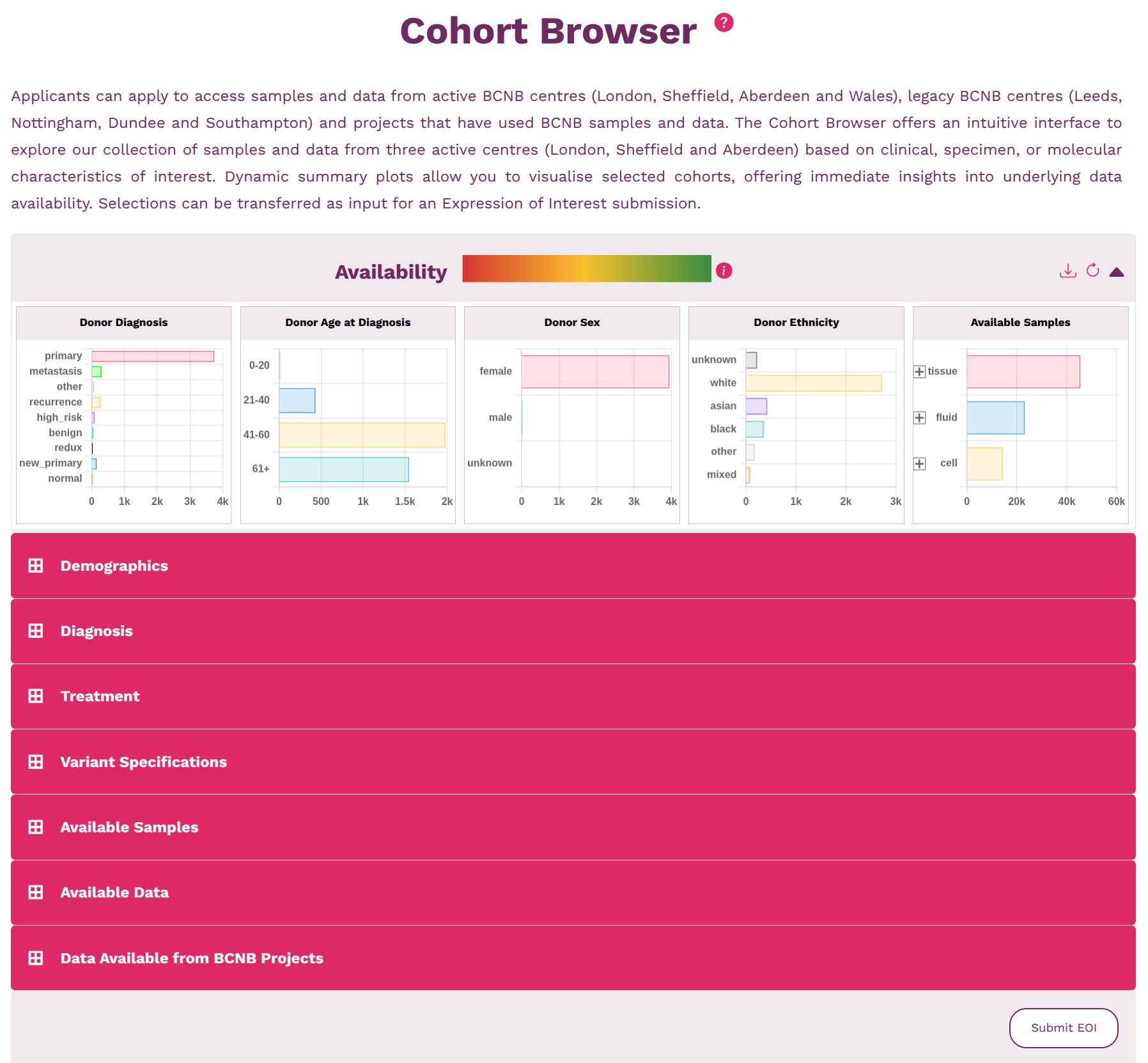
The Cohort Browser offers an intuitive interface to explore our collection of samples and data from three active centres (London, Sheffield and Aberdeen) based on clinical, specimen, or molecular characteristics of interest.
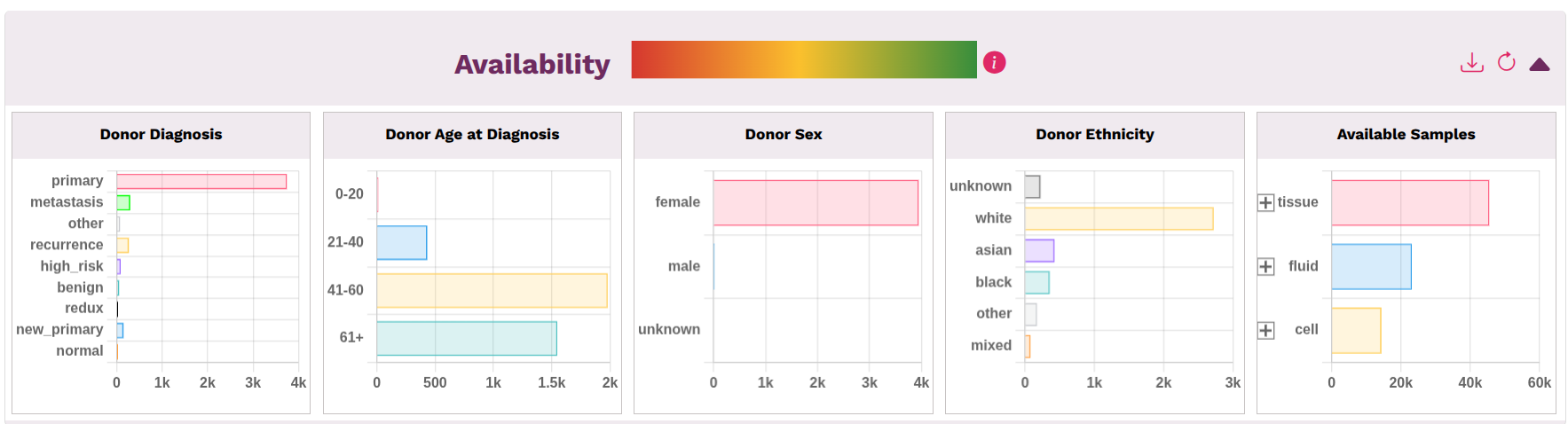
Dynamic summary plots provide a powerful way to visualise the selected cohorts, enabling you to gain immediate insights into the underlying data availability and characteristics.
These visualisations help you quickly assess the distribution of samples and identify any potential gaps in the data.
Specific cohort selections can be saved and transferred directly into an Expression of Interest (EOI) submission for seamless data access requests.
Summary Panel
The summary panel updates automatically after every filter action (selection, deselection, slider change, and clear action).
Donor Availability: shows the percentage of available donors matching your filters. Use this to check if your cohort size is reasonable. If too small, your sample/data request may not be feasible.
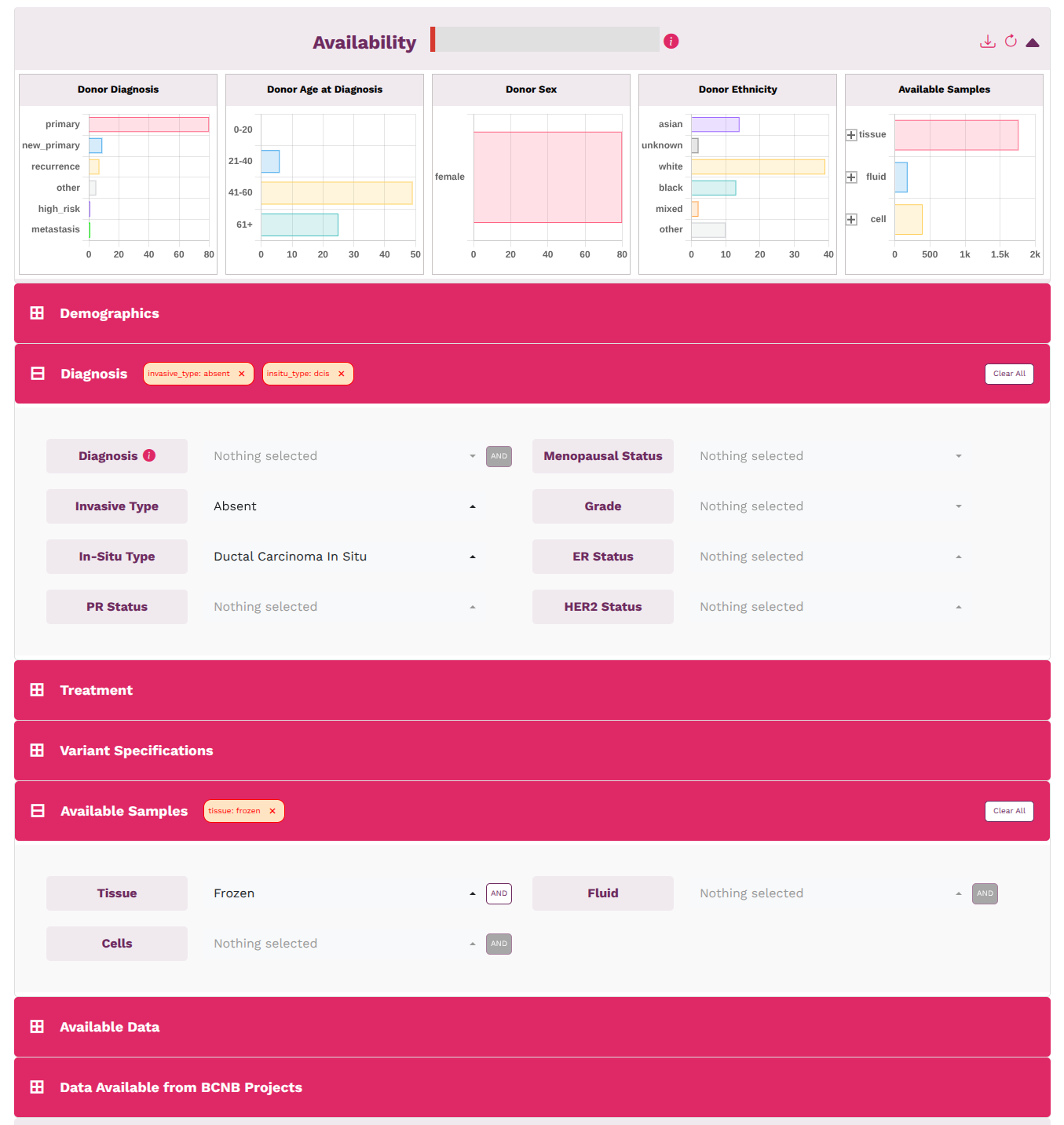
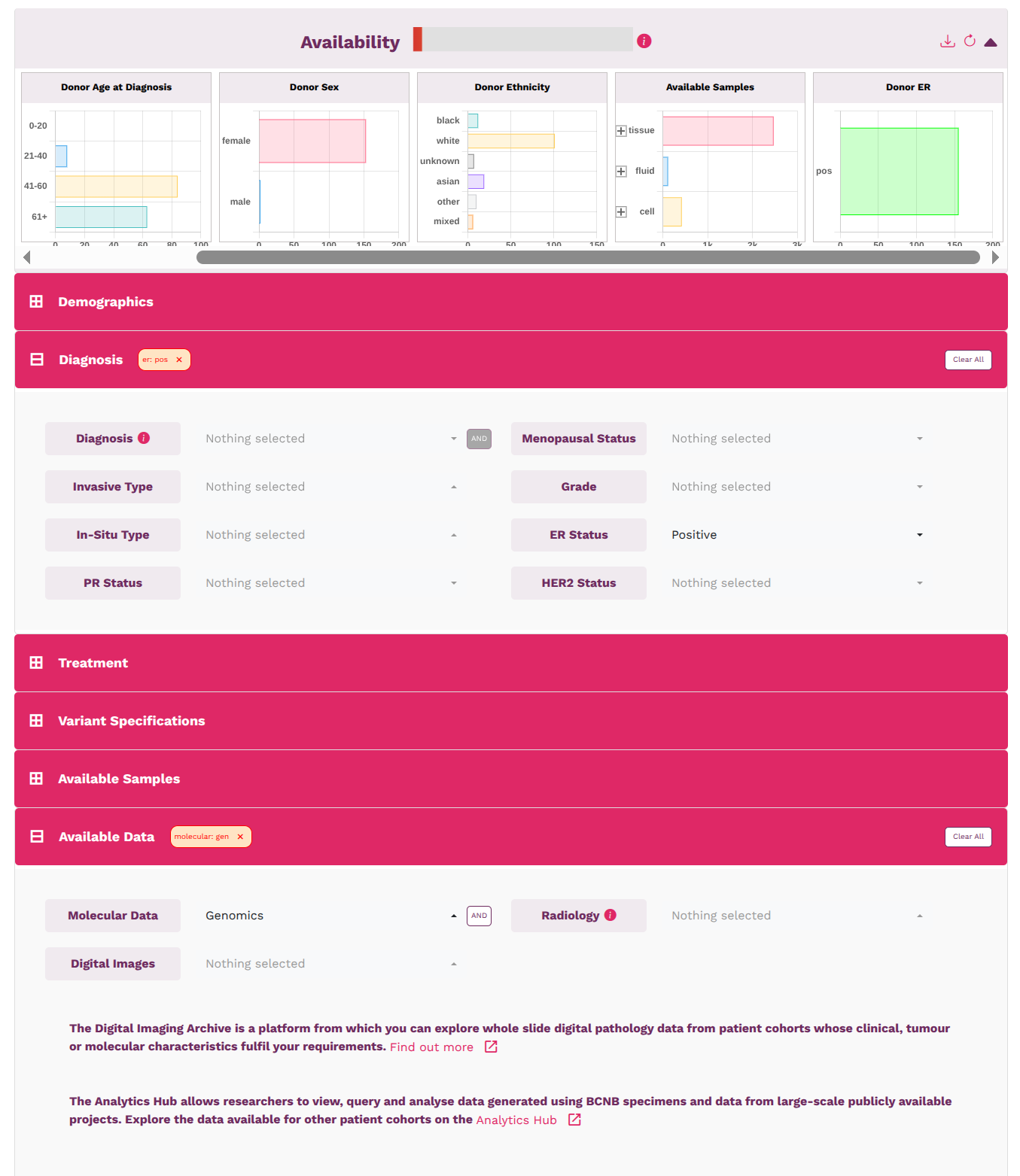
Dynamic Summary Plots: provide visual representations of the selected cohort's characteristics. You can view the distribution of donors and samples across the cohort, e.g., donor diagnosis, donor age at diagnosis and available samples.
You can have a quick visual check of the cohort composition and data availability.
For example, if you are looking for a cohort with frozen tissue, you can check the "Available Samples" plot to see the distribution of sample types in your selected cohort. If you find that the majority of samples are FFPE, you may want to relax some filters to increase the number of frozen samples.
Use these plots to validate that your filters are working as expected and to understand the composition of your cohort.
Filters
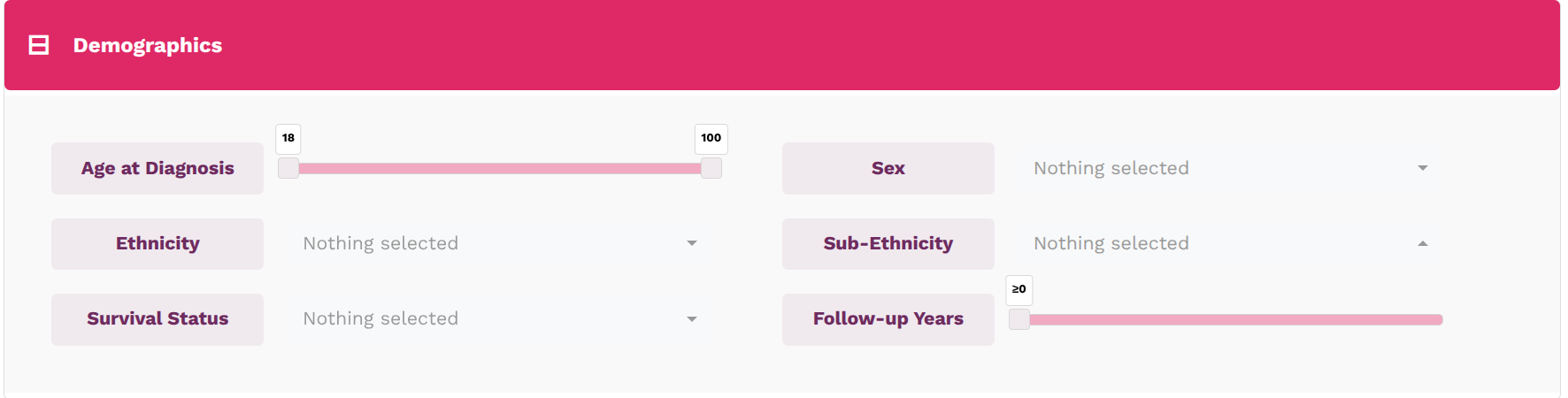
Demographics: define patient-level characteristics such as age, sex, ethnicity, survival status, and follow-up duration.
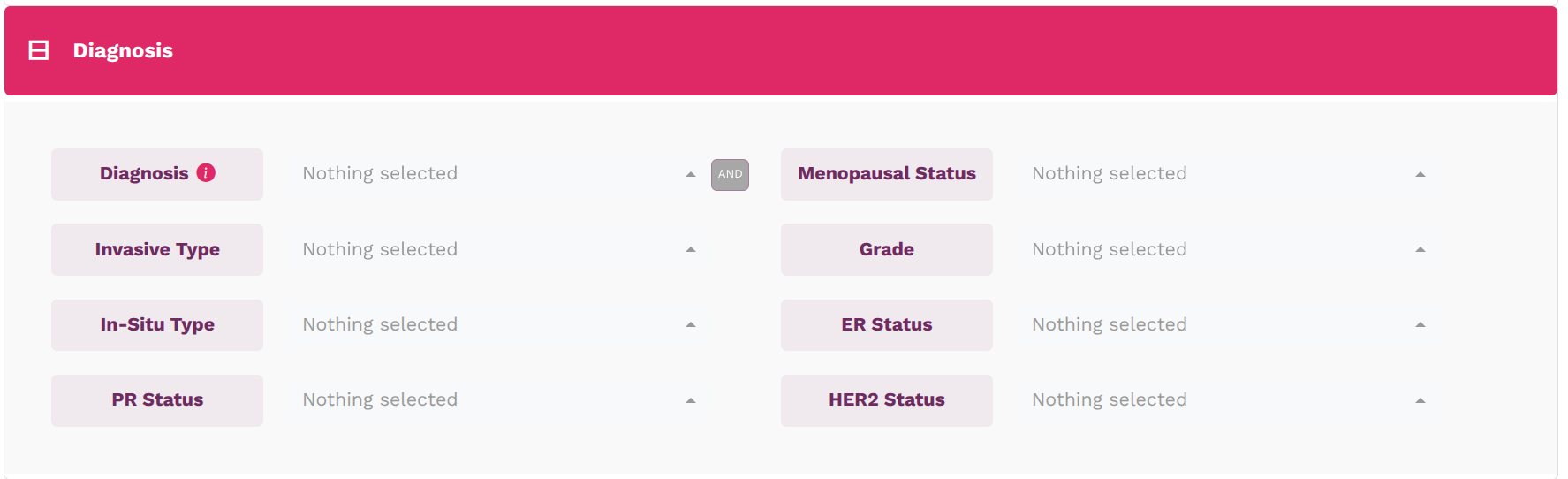
Diagnosis: refine by clinical phenotype, including diagnosis group, menopausal status, tumour type, grade, and receptor markers (ER/PR/HER2).
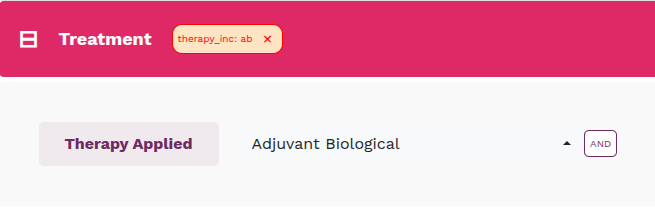
Treatment: include or exclude therapy categories. When multiple options are selected within a filter, the cohort includes samples matching any of those options (OR logic). For example, selecting both "Adjuvant Biology" and "Adjuvant Chemotherapy" returns samples receiving either treatment. Use the AND filter to require samples matching all selected options across categories, enabling stricter cohort refinement.
Variant Specifications: filter by known variant status (currently BRCA1/BRCA2).
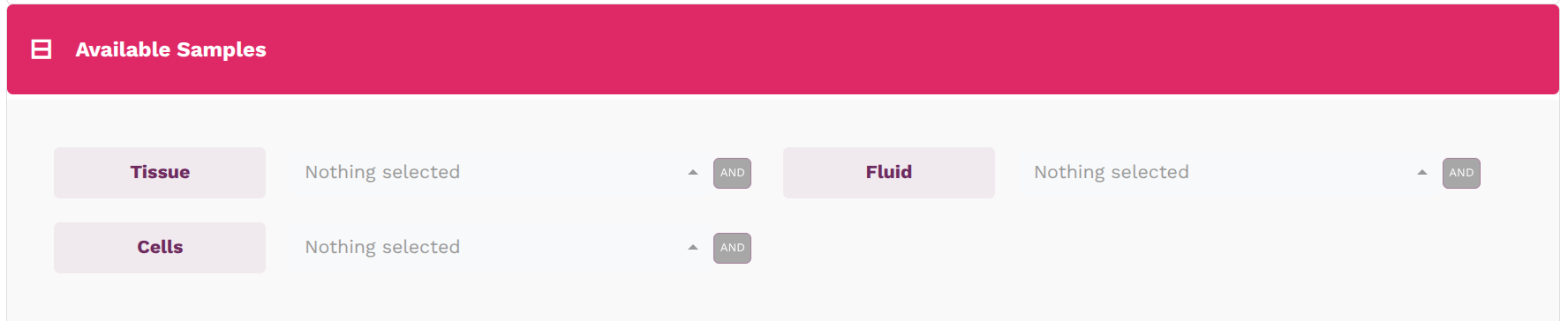
Available Samples: target material needed for your study (tissue/fluid/cells). For tissue samples, fresh and TMA are available upon request. If you want to check that a donor has multiple samples available for research, use the AND filter to check donor availability.
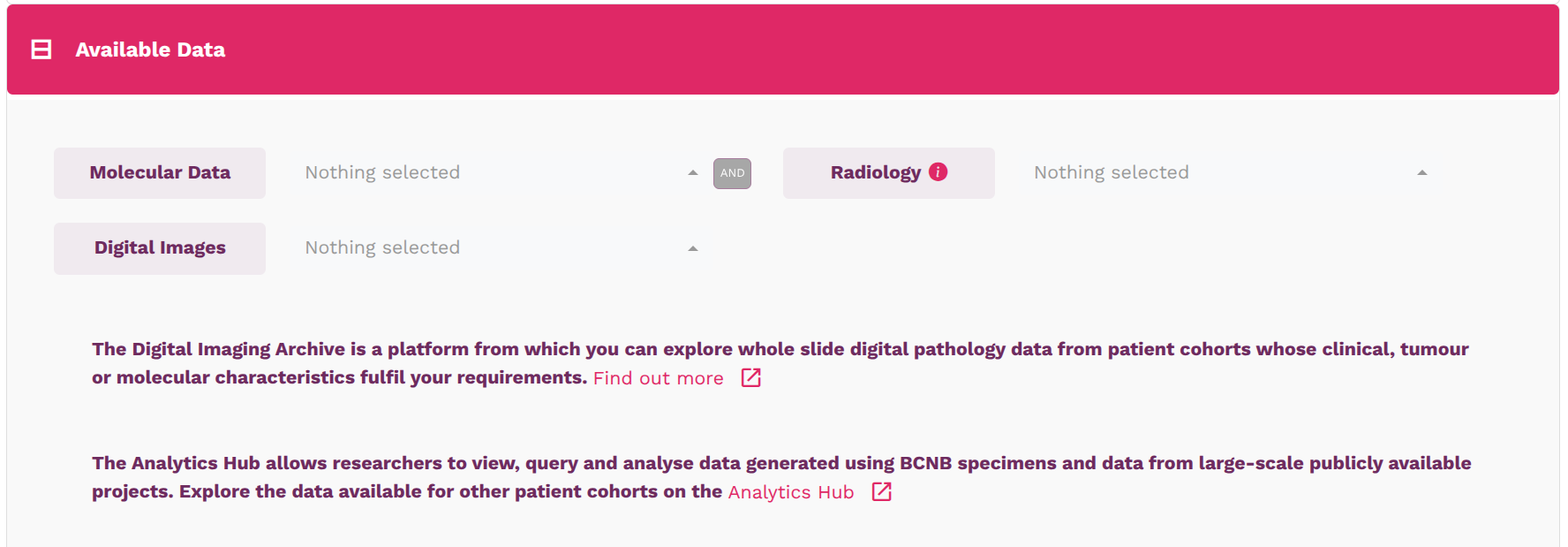
Available Data: we have molecular data (Genomics and Transcriptomics data), radiology images, and digital images (whole slide images) available for selection.
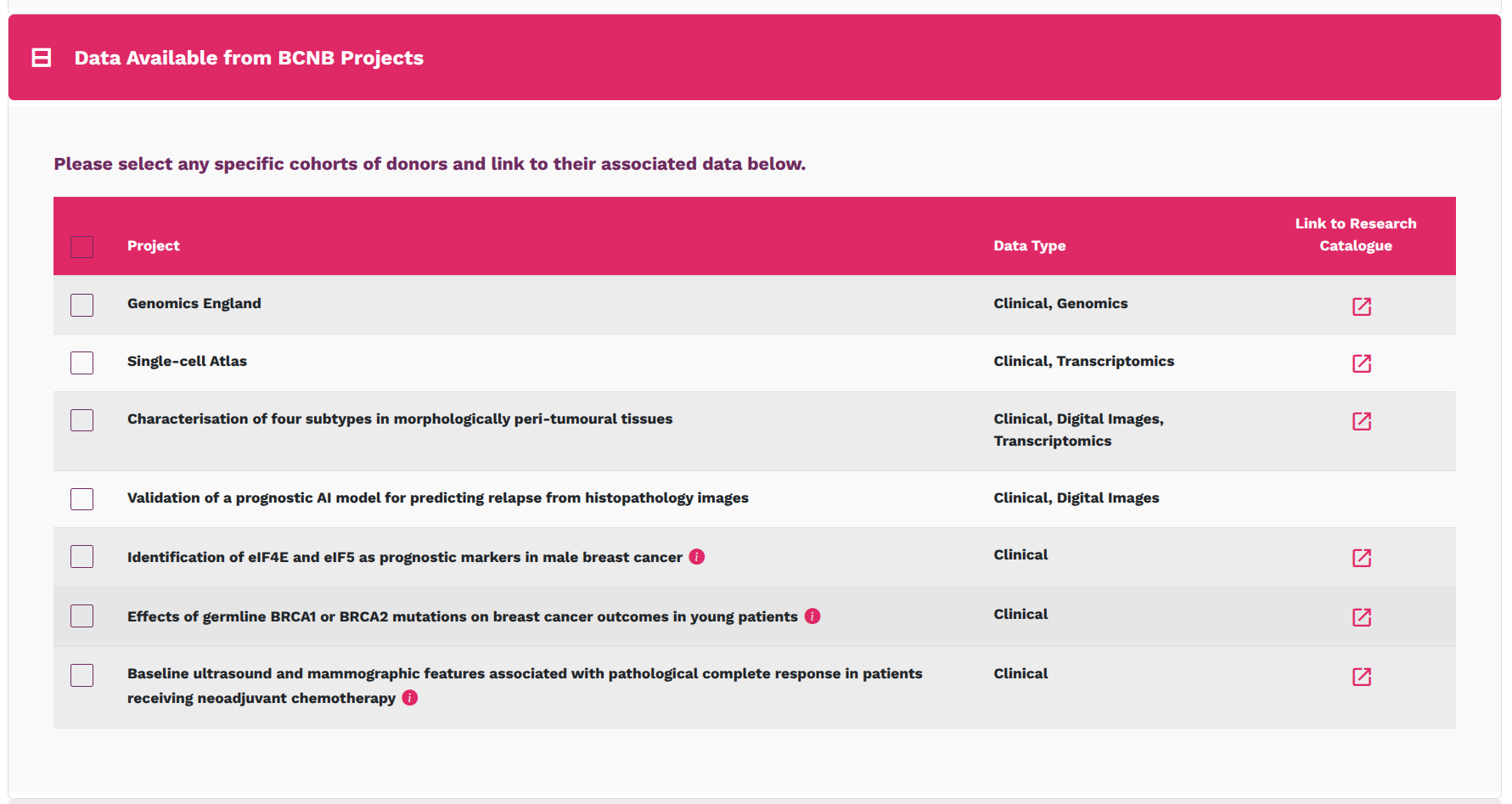
Data Available from BCNB projects: explore datasets derived from existing BCNB projects. You can select any project by clicking the checkbox at the front of the project for your request.
Use each section’s Clear All to reset one category while preserving all other selected criteria.
Filter Construction Logic
Default: The different filters are connected with "AND" logic,
and the options inside each filter are connected with an "OR" logic.
For example, if you want to find donors with "white" or "black" ethnicity groups,
you can select both options in the "Ethnicity" filter and they will be connected with an "OR" logic.
AND filter: when you want to have a stricter cohort definition,
you can use the AND filter to connect different options inside one filter.
For example, if you want to find donors with both "Adjuvant Biological"
and "Adjuvant Chemotherapy" therapy treamtments,
you can first select "Therapy Applied: Adjuvant Biological" in the "Treatment" section.
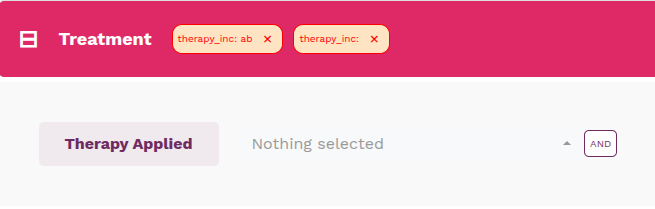
Then click the AND button next to "Therapy Applied" to apply an AND logic to this filter section.
A new empty condition with the same filter option block "therapy_inc:" will be added to the filter section.
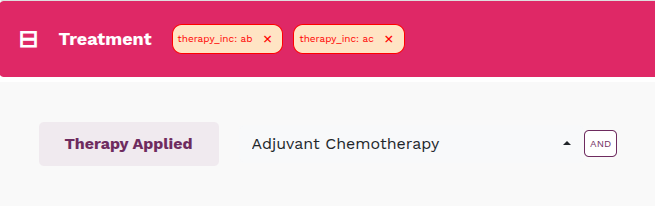
Once an empty condition is added to the filter section, you can select "Therapy Applied: Adjuvant Chemotherapy" in the new empty condition.
This will give you a more specific cohort that has both treatments.